

A college student messaged me saying her GPA looked wrong. She earned an A in a 4-credit course and a C in a 1-credit elective. Her spreadsheet showed B, but the real GPA was much closer to A because the 4-credit class carried four times the weight. This is exactly the problem a weighted average calculator solves in seconds.
Not every number matters equally. A weighted average calculator produces results that reflect reality. This guide covers how it works, when to use it, and the mistakes that trip people up most.
What Is a Weighted Average Calculator?
A weighted average calculator is a digital tool that computes an average where each value contributes according to its assigned importance, or weight. It multiplies every value by its weight, then divides by the sum of all weights.
Weighted Average Calculator Definition
This calculator accepts two inputs per data point: value and weight. Professors, portfolio managers, and researchers all use the same tool. Only the data changes.
What Does a Weighted Average Calculator Do?
It multiplies each number by its weight, sums those products, and divides by total weight. The result shows where your data centers when some values count more. Try our weighted average calculator to see this in action.
Why Is It Different from a Regular Average Calculator?
A regular calculator treats every item equally. When items have varying significance, equal treatment distorts results. The weighted version fixes that by letting you assign importance levels.
Interactive: Weighted vs Simple Average
Live DemoStudent scores: Math (95), Art (80), Gym (70)
Drag the weight slider to see how weight changes the result:
What Is a Weighted Average?
A weighted average multiplies each value by a weight reflecting its importance, then divides the sum of products by total weight. It produces a more accurate central tendency when data points have unequal significance.
Weighted Average Meaning
"Weighted" means adjusted for importance. The weighted mean calculator applies this same principle to produce averages where some numbers matter more.
How a Weighted Average Differs from a Simple Average
A simple average adds values and divides by count. If you scored 90, 80, and 70, the simple average is 80. But if the first test is worth 50%, the second 30%, and the third 20%, the weighted average becomes 83. That difference can change a letter grade.
Why Some Values Carry More Weight
Real-world data rarely comes in equal portions. A final exam matters more than homework. A large stock holding affects returns more than a small one.
Real-Life Analogy
Mix five cups of blue paint with one cup of white. The result is mostly blue because blue carries more "weight." Weighted averages work the same way.
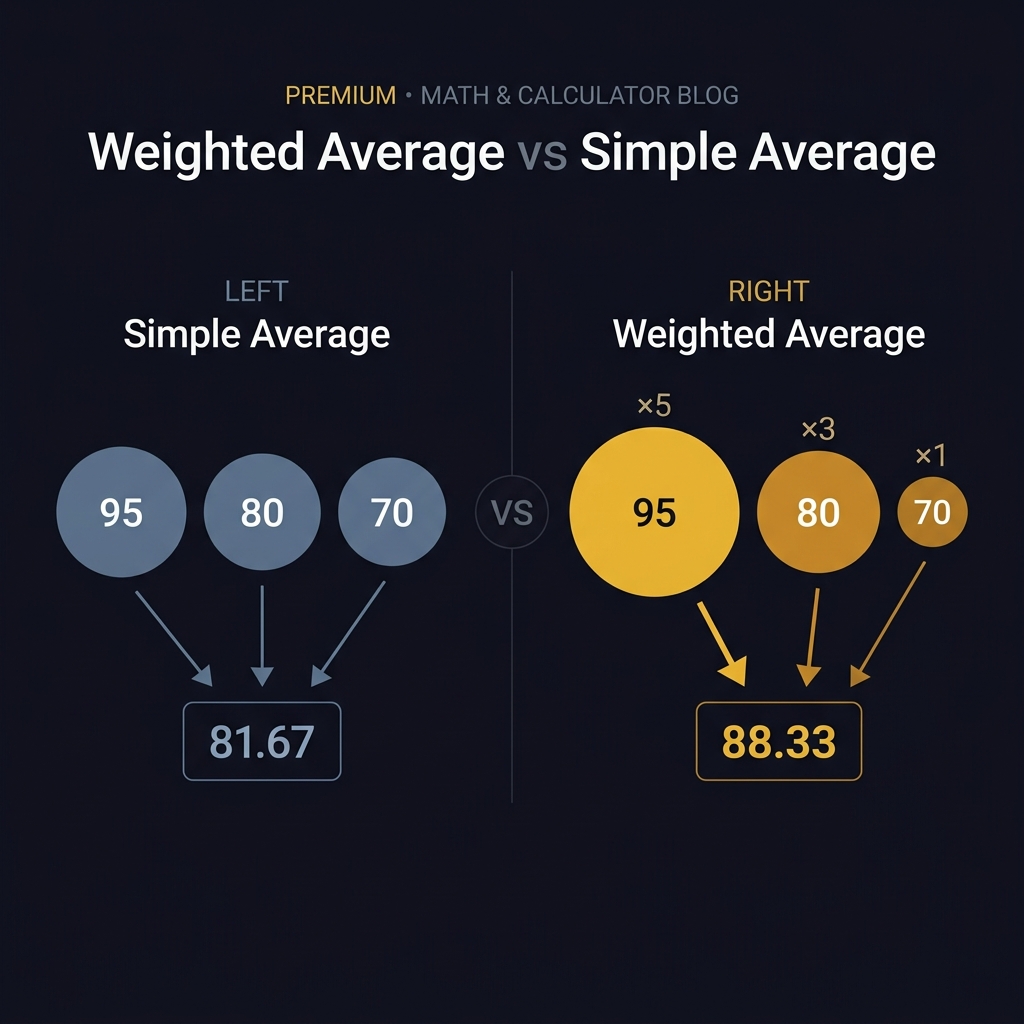
Visual comparison of how weighted and simple averages produce different results from the same data set
Why Do You Need a Weighted Average Calculator?
You need a weighted average calculator because manual calculations with unequal weights are slow, error-prone, and increasingly complex as data sets grow.
Saves Time
Calculating by hand for five items takes about two minutes. For twenty items, closer to ten. The calculator does it in under one second regardless of data size.
Eliminates Manual Calculation Errors
Misplacing a decimal, forgetting to multiply, or dividing by the wrong total are common human errors. The calculator follows the formula perfectly every time.
Works with Large Data Sets
When you work with 100 survey responses or 50 stock positions, manual computation becomes unrealistic. The weighted average calculator for statistics handles large data sets effortlessly.
Calculates Results Instantly
As you update values or weights, the calculator adjusts the result immediately. You see the impact of every change as it happens.
How the Weighted Average Formula Works
Step-by-StepHow Does a Weighted Average Calculator Work?
A weighted average calculator works through four sequential steps: entering values, assigning weights, multiplying pairs, and dividing by the total weight.
Enter Your Values
Type the numbers you want to average: test scores, stock prices, ratings, or any numerical data.
Assign a Weight to Each Value
Assign a weight representing each value's importance. A final exam might get weight 5 while a quiz gets 1. Weights can be whole numbers, decimals, or percentages.
Multiply Values by Their Weights
The calculator multiplies each value by its weight. If your exam score is 92 and its weight is 5, the product is 460.
Divide by the Total Weight
The sum of all products is divided by the sum of all weights, producing your weighted average.
Display the Final Weighted Average
The result appears instantly along with supporting data like total weight and sum of products for verification.
What Information Do You Need Before Using a Weighted Average Calculator?
You need two pieces of information for each data point: the value itself and its corresponding weight.
Values
Values are the raw numbers to average: test scores (85, 92, 78), stock prices (150.25, 48.00), or satisfaction ratings (4.5, 3.8, 4.2).
Weights
Weights represent relative importance: credit hours, investment amounts, or sample sizes. The weighted grade calculator uses credit hours as weights.
Matching Value-Weight Pairs
Every value must have exactly one weight. Mismatched lists produce incorrect results or errors.
Can Weights Be Percentages?
Yes. Percentage weights work perfectly. Just stay consistent and do not mix 40% with 0.3 in the same calculation.
Can Weights Be Decimals?
Yes. Decimal weights like 0.5, 1.75, or 3.2 are fully supported and processed identically to whole numbers.
Weight Distribution Visualizer
InteractiveWhat Can You Calculate with a Weighted Average Calculator?
You can calculate any scenario where data points carry different levels of importance. Applications span education, finance, research, and beyond.
Student Grades
Assignments, quizzes, midterms, and finals carry different weights. A weighted average gives you the true course grade.
GPA
A 4-credit A matters more than a 1-credit B. The weighted average produces an accurate GPA reflecting both performance and course load.
Investment Returns
A portfolio with $50,000 in stocks and $5,000 in bonds should not give equal weight to both. The weighted investment calculator ensures larger positions dominate the average return.
Survey Results
When survey groups have different sample sizes, weighting produces a result that represents the entire population fairly.
Product Ratings
A product with 500 five-star reviews and 10 one-star reviews deserves weighting by review count for a fair overall score.
Business Performance Metrics
Revenue from different divisions or satisfaction across regions benefits from weighted averaging when segments are unequal in size.
When Should You Use a Weighted Average Calculator?
Use a weighted average calculator whenever your data points have unequal importance, frequency, or volume.
Education
Compute final grades where assignments carry different weights, or calculate GPA across courses with varying credit hours.
Finance
Calculate weighted returns, cost of capital, and bond maturity analysis across diverse portfolios.
Statistics
Apply weights to survey data when demographic groups differ in size to ensure representative results.
Accounting
The weighted average cost method values inventory by weighting purchase prices by quantity bought at each price.
Research
Combine findings from studies with different sample sizes into a single representative value.
Business Reporting
Weight KPIs by division size or regional revenue to produce dashboards that reflect organizational reality.
Benefits of Using a Weighted Average Calculator
The core benefit is accuracy that reflects reality rather than mathematical oversimplification.
Improves Accuracy
By honoring each data point's importance, the weighted average produces a result closer to the true center of your data.
Saves Time
What takes minutes by hand takes seconds with the tool, adding up fast for regular calculations.
Handles Complex Calculations
The calculator handles fifty data points as easily as five.
Reduces Human Error
Automated calculations eliminate misplaced decimals, forgotten multiplications, and division mistakes.
Suitable for Multiple Industries
Education, finance, marketing, healthcare, manufacturing, and real estate all use weighted averages. One tool serves every field.
Weighted Average Calculator vs Regular Average Calculator
The fundamental difference is that a weighted calculator treats values unequally based on assigned importance, while a regular calculator treats every value the same.
Equal Weight vs Unequal Weight
A simple average divides by count. A weighted average divides by total weight. When all weights equal 1, both give the same answer. The difference emerges when weights vary.
Accuracy Comparison
For data with varying importance, the weighted version is always more accurate. For truly equal data, both produce identical results.
Which One Should You Use?
Does every data point matter equally? If yes, use a simple average. If no, use a weighted average.
Quick Comparison Table
| Feature | Regular Average | Weighted Average |
|---|---|---|
| Treatment of values | All equal | Based on assigned weight |
| Accuracy for unequal data | Low | High |
| Use in GPA calculation | Incorrect | Correct |
| Portfolio return analysis | Misleading | Accurate |
| Computation complexity | Simple | Moderate |
| Best for | Equal data sets | Real-world data |

Weighted average calculations serve education, finance, business, and research industries worldwide
Common Mistakes When Using a Weighted Average Calculator
Even with automated tools, input errors can produce misleading results.
Entering Incorrect Weights
Typing 50 when you meant 5 drastically changes the outcome. Always double-check weight entries before reviewing results.
Using Mismatched Value and Weight Lists
Every value needs exactly one weight. Leaving a weight blank or adding an extra value without a weight produces errors.
Assuming Weights Must Total 100%
Weights can total any number. The formula divides by the sum of all weights automatically, whether they add to 9 or 900.
Mixing Percentages and Decimal Weights
Using 30% for one item and 0.4 for another creates chaos. Pick one format and stick with it.
Who Can Benefit from a Weighted Average Calculator?
Anyone who works with data where some values matter more than others benefits from this tool.
Students
Calculate final grades and GPA accurately before exams.
Teachers
Compute class averages with proper assignment weighting, saving hours every semester.
Financial Analysts
Measure weighted returns, cost of capital, and average interest rates across portfolios.
Investors
Track portfolio performance using the weighted stock average calculator to see how each holding affects returns.
Researchers
Combine results from studies with different sample sizes into a single meaningful statistic.
Business Owners
Analyze satisfaction, performance, and revenue metrics with appropriate weighting for segment sizes.
Data Analysts
Process survey data and operational metrics where weighting by sample size or revenue is standard.
Limitations of a Weighted Average Calculator
While powerful, a weighted average calculator has boundaries users must understand.
Depends on Accurate Input
The calculator only produces correct results with correct inputs. Garbage in, garbage out.
Cannot Choose Appropriate Weights for You
Deciding weight assignments requires domain knowledge and judgment. The tool computes; you decide the weights.
Not Suitable for Every Averaging Problem
Some situations call for geometric means, harmonic means, or medians. A weighted average is not always the right measure.
Frequently Asked Questions
What is a Weighted Average Calculator?
An online tool that multiplies each value by its weight, sums the products, and divides by total weight to produce a single representative number.
What is the purpose of a Weighted Average Calculator?
To give greater influence to values that matter more. Students use it for GPA, investors for portfolio returns, and researchers for combining study results.
Is a Weighted Average Calculator the same as a weighted mean calculator?
Yes. Both describe the same computation. Weighted mean is the statistical term; weighted average calculator is the common search phrase.
What is the difference between a weighted average and a regular average?
A regular average treats every value equally. A weighted average assigns weights so more important items have a bigger impact on the result.
Can I use percentages as weights?
Yes. Stay consistent and avoid mixing percentages with decimals in the same calculation.
Do weights have to add up to 100%?
No. Weights can total any number. The formula divides by the sum of weights automatically.
Can weights be decimal numbers?
Yes. Decimal weights like 0.3, 1.5, or 2.7 work perfectly and are processed like whole numbers.
Who uses a Weighted Average Calculator?
Students, teachers, financial analysts, investors, researchers, business owners, and data analysts across education, finance, and research sectors.
Is a Weighted Average Calculator accurate?
Yes. With correct inputs, it delivers precise results using a standard formula trusted across every industry.
What industries use Weighted Average Calculators?
Education, finance, statistics, accounting, market research, business reporting, manufacturing, healthcare, and real estate all rely on weighted averages.
Conclusion
A weighted average calculator is the correct way to handle data where importance varies across items. From predicting final grades to measuring portfolio returns, it replaces guesswork with precision.
If you work with grades, financial data, survey results, or any numbers where some values matter more than others, stop using simple averages. Start with our free weighted average calculator and see the difference in your very first calculation.
What data set would you like to weight first? Your course grades, your investment portfolio, or something else entirely? The tool is ready whenever you are.