How to Calculate Weighted Grades and GPA
Multiply each grade by its weight for a course grade, and each grade point by its credit hours for GPA. Formulas, examples and a final exam solver.
weighted gradesgpacredit hours
Multiply each grade by its weight for a course grade, and each grade point by its credit hours for GPA. Formulas, examples and a final exam solver.
weighted gradesgpacredit hours
Two numbers decide an academic record, and almost nobody is taught to calculate either one. A course grade weights assignments by their share of the syllabus. A GPA weights courses by their credit hours. Same arithmetic, different weight column.
Here is the part students discover too late. Sitting at 81.50 with the final exam still ahead, you need a 90.25 to finish on a B and a 102.75 to finish on an A. One of those is a study plan. The other is a decision to stop worrying.
This guide covers both calculations end to end, plus cumulative GPA and the running grade you can compute mid-term. Every figure is worked in full. The weighted grade calculator and the weighted average calculator will do it for you afterwards, and how to calculate a weighted average covers the method behind both.
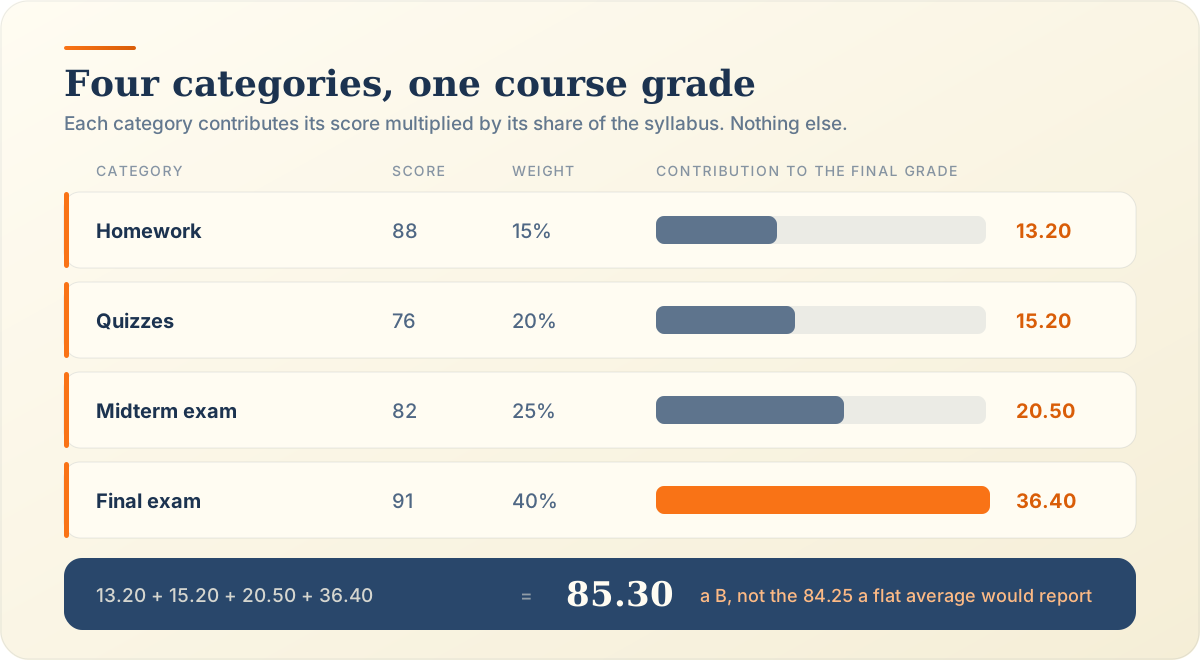
A weighted grade is a course grade where each assignment category counts for a set share of the total. A final exam worth 40 percent influences the result four times as much as homework worth 10 percent, regardless of how many homework assignments there were.
Your syllabus splits the course into categories and assigns each a percentage. Those percentages are the weights, and together they cover the whole course.
Instructors weight by what the work proves. A comprehensive final tests the whole course, so it outranks one problem set. That judgement happens before the term starts, not after grades arrive.
An equal-weight course averages every score identically. A weighted course does not. Above, the flat average is 84.25 and the weighted grade is 85.30. Only one of them reaches a transcript.
List every category with its score and weight, convert the weights to decimals, multiply each score by its weight, add the products, and the total is your course grade. When weights total 100 percent, that sum is the final answer with no further division.
Write one row per category, straight from the syllabus. Confirm the weight column totals 100 before you go further. A column reaching 95 means you missed a category.
Divide each weight by 100. A 40 percent final becomes 0.40. The step is optional. The alternative is simply dividing by 100 at the end.
Work down the rows. A score of 91 on a category worth 0.40 contributes 36.40 points. Nothing else on the row affects that product.
Sum the contribution column. For the four categories above, 13.20 plus 15.20 plus 20.50 plus 36.40 gives 85.30.
With decimal weights totalling 1.00, the sum is already your grade. With whole numbers totalling 100, divide by 100 first. Both routes land on 85.30.
Every category is graded, so this is the final course grade rather than a running one.
Edit a score above, then clear one entirely. The completed weight drops and the heading changes from a final grade to a running one. That distinction matters enormously in week six.
The weighted grade formula is the sum of each score multiplied by its weight, divided by the total of the weights. When weights add to 100 percent, the division is by 100. When only some categories are graded, divide by the weight completed so far.
The score is what you earned. The weight is how much that category counts. Reversing the two is the most common error here, and the result still looks like a plausible grade.
The normal case. Multiply, add, divide by 100. Because the denominator is fixed, each contribution reads directly as points out of 100, which makes the arithmetic easy to check in your head.
Divide by the weight actually graded instead of by 100. Three categories covering 60 percent of the course produce a current grade, not a final one. Never treat ungraded work as a zero.
A course weighting homework 15 percent, quizzes 20 percent, the midterm 25 percent and the final 40 percent, with scores of 88, 76, 82 and 91, produces a weighted course grade of 85.30 against a flat average of 84.25.
| Category | Score | Weight | Contribution |
|---|---|---|---|
| Homework | 88 | 15% | 13.20 |
| Quizzes | 76 | 20% | 15.20 |
| Midterm exam | 82 | 25% | 20.50 |
| Final exam | 91 | 40% | 36.40 |
| Totals | — | 100% | 85.30 |
Each contribution is score times decimal weight. Quizzes scored 76 at 0.20, contributing 15.20. That is the weakest score in the table, and its low weight limits the damage.
13.20 + 15.20 + 20.50 + 36.40 = 85.30
That lands in the B band on most scales. The flat average of 84.25 also reads as a B. The two figures diverge far more sharply when a heavily weighted category runs against the trend.
Convert each letter grade to a grade point, multiply by the course credit hours to get quality points, add all the quality points, then divide by total credit hours. Credit hours are the weights in a GPA, which is why a 4-credit course moves it four times as hard as a 1-credit one.
Credit hours measure how much workload a course represents, usually tied to weekly contact time. A 4-credit lab demands roughly four times the commitment of a 1-credit seminar.
Grade points convert letters to numbers on a fixed scale. An A is 4.0, a B+ is 3.3, a C+ is 2.3. Your institution publishes the exact values. Plus and minus figures vary more than people expect.
The middle column is the number that enters a GPA calculation. The right column never does.
A grade point on its own says nothing about how much the course counts. Credit hours supply that missing information, and dropping them turns a GPA into a plain average of letters.
Quality points are grade points times credit hours. A B+ worth 3.3 in a 4-credit course yields 13.2. This single column is where most hand-calculated GPAs go wrong.
GPA equals total quality points divided by total credit hours. Quality points come from multiplying each grade point by that course’s credit hours. The denominator is always credits, never the number of courses.
One multiplication per course. Keep the products unrounded. Rounding each row before adding introduces drift that compounds across a full transcript.
Add the column. A typical 15-credit semester lands between 0 and 60. That size is normal, because the figure has not been divided yet.
Add the credit column separately, then compare it to your registration record. A mismatch means a course is missing or duplicated.
Divide quality points by credit hours and round to two decimals. The weighted GPA calculator prints both totals separately, so you can check each half on its own.
Five courses totalling 15 credit hours and 49.9 quality points produce a GPA of 3.33. Averaging the five grade points alone gives 3.26, because that shortcut ignores which courses carried the heaviest loads.
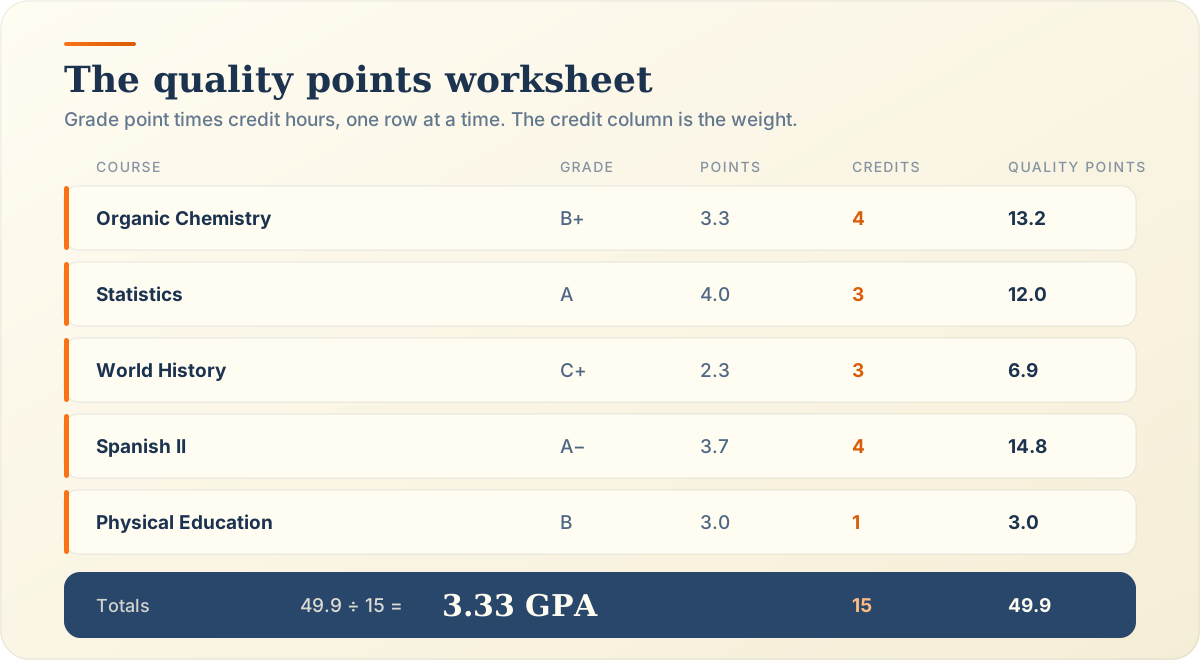
Averaging the five grade points alone gives 3.26. Credit hours pull the real GPA to 3.33.
Drop Organic Chemistry to a C. The GPA falls further than dropping Physical Education to an F. Four credits against one, doing exactly what the weights promise.
13.2 plus 12.0 plus 6.9 plus 14.8 plus 3.0 gives 49.9. Add the column twice, working upward the second time. Reversing direction catches what the first pass missed.
49.9 ÷ 15 = 3.33 GPA
Add the quality points from every semester and divide by all credit hours attempted. Never average your semester GPAs directly, because a 6-credit summer term does not deserve the same voice as a 16-credit spring.
A semester GPA covers one term. A cumulative GPA covers everything you have taken. Same formula, different range of rows.
Rebuild the totals rather than reusing the averages. Multiply each semester GPA by its credits to recover the quality points, then add everything.
(3.33 × 15) + (3.72 × 16) + (2.90 × 6) = 126.82 → 126.82 ÷ 37 = 3.43
Averaging the three semester figures gives 3.32. That 0.11 gap comes entirely from treating a 6-credit summer as an equal partner. The guide on weighted average vs simple average shows the same trap in other settings.
Use only the categories already graded. Multiply each score by its weight, add the products, then divide by the weight completed rather than by 100. That gives an honest running grade instead of a number depressed by work nobody has marked yet.
Homework at 88, quizzes at 76 and the midterm at 82 cover 60 percent of the course. Their contributions total 48.90 points.
48.90 ÷ 0.60 = 81.50 current grade
Dividing by 100 instead reports 48.90, which is not a grade and not a warning. It is just wrong. The weighted percentage calculator tracks completed weight separately.
Tough but reachable. A 90.25 on the final lands the course on exactly 85.00.
Set the target to an A and watch the number pass 100. That is the honest answer, and it arrives early enough to matter. Chasing an unreachable grade costs time another course could use.
An unweighted GPA caps every course at 4.0 regardless of difficulty. A weighted GPA adds points for Advanced Placement, International Baccalaureate and Honors courses, typically 1.0 and 0.5, so the scale can run past 4.0.
Every course sits on the same 4.0 scale. An A in Ceramics and an A in AP Chemistry both score 4.0. That rewards results and ignores rigour entirely.
Difficulty earns a bonus before credit hours enter the calculation. Most districts add 1.0 for AP and IB and 0.5 for Honors, though caps vary. The College Board documents how AP results feed placement and credit decisions separately from GPA.
| Course | Grade | Credits | Unweighted points | Weighted points |
|---|---|---|---|---|
| AP Chemistry | A− | 4 | 14.8 | 18.8 |
| Honors Precalculus | B | 4 | 12.0 | 14.0 |
| English 10 | A | 3 | 12.0 | 12.0 |
| Ceramics | B− | 2 | 5.4 | 5.4 |
| GPA across 13 credits | — | 13 | 3.40 | 3.86 |
The 0.46 gap comes from two courses. For the full comparison, see weighted vs unweighted GPA.
Five mistakes cause most wrong results: treating assignments as equal, mixing percentage and decimal weights, skipping the credit-hour multiplication, dividing by course count, and using a grade-point scale your school does not actually use.
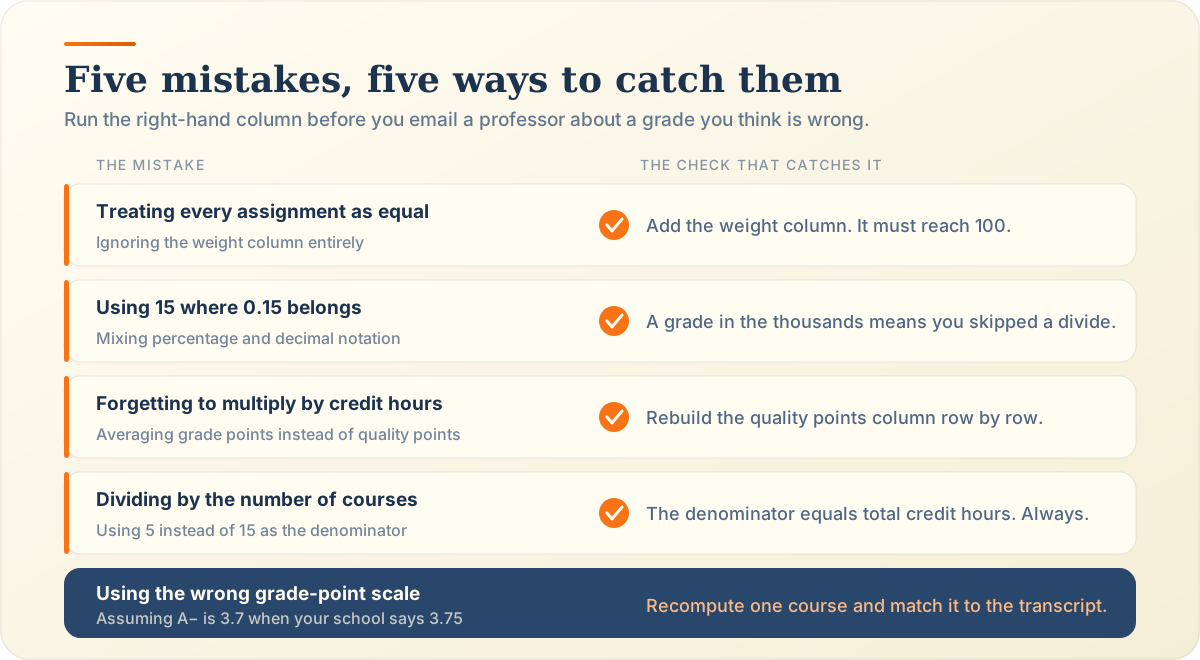
The default error. Averaging four category scores ignores the syllabus that defined them. Nobody notices, because the answer still looks like a grade.
Multiplying by 15 instead of 0.15 inflates everything by a hundred. A course grade in the thousands means you skipped the final division, not that you miscalculated.
Averaging grade points without credits gave 3.26 instead of 3.33 above. The error grows whenever your best and worst grades sit in courses of very different sizes.
Dividing 49.9 by 5 courses gives 9.98, which is not a GPA on any scale. The denominator is total credit hours, and it never changes to anything else.
Some institutions score A− as 3.67, others as 3.7, a few as 3.75. Across 40 courses that moves a cumulative GPA visibly. Read your handbook once rather than guessing forty times.
Confirm the weights total 100 percent, rebuild the quality points column, verify the credit total against your registration record, and compare one finished course against your official transcript. Four checks, under two minutes.
Add the weight column before anything else. It should reach exactly 100. A total of 90 or 110 means a category is missing or double counted.
Recompute every grade point times credit hours, working from the bottom upward. Reversing direction breaks the pattern that let the original slip through.
Compare your credit total to your enrolment record. This catches dropped courses, withdrawn courses and pass-fail courses that should never have entered the calculation.
Recalculate a past semester where you already know the official GPA. Matching it proves your scale and method before you trust them on a semester that still matters. The weighted mean calculator and the weighted average mark calculator print intermediate totals for exactly this audit.
Multiply every category score by its weight as a decimal, then add the products. Homework at 88 with a 0.15 weight contributes 13.20. When the weights total 1.00, that sum is your course grade directly. With whole-number weights totalling 100, divide the sum by 100 at the end instead.
Convert each letter grade to its grade point, multiply by that course’s credit hours to get quality points, add every quality point, then divide by total credit hours. A B+ in a 4-credit course contributes 13.2. Five courses totalling 49.9 quality points across 15 credits give a 3.33 GPA. The denominator is credits, never the number of courses.
Yes, and that is the entire design. A 4-credit course influences your GPA four times as strongly as a 1-credit course with the same grade. A poor grade in a lab science therefore hurts far more than the same grade in a one-credit elective. Protect your heaviest courses first.
Add the quality points from every semester and divide by every credit hour attempted. To recover a past semester’s quality points, multiply its GPA by its credits. Three semesters of 3.33 over 15, 3.72 over 16 and 2.90 over 6 give 126.82 quality points across 37 credits, which is a 3.43 cumulative GPA. Averaging the three GPAs directly would have reported 3.32.
An unweighted GPA caps every course at 4.0 regardless of difficulty. A weighted GPA adds a bonus for harder courses, usually 1.0 for AP and IB and 0.5 for Honors, so the maximum can reach 5.0. The same transcript can yield 3.40 unweighted and 3.86 weighted. Admissions offices often recalculate both on their own scale anyway.
Yes, using only courses with final grades posted. Courses still in progress have no grade point, so exclude them from both totals. Including them as zeros produces a number that is wrong and needlessly alarming. Recalculate as each set of grades posts.
Multiply your target by 100, subtract the points already banked, then divide by the weight remaining. Sitting at 81.50 across 60 percent of the course with a target of 85, that is (8500 − 4890) ÷ 40, which equals 90.25. A result above 100 means the target is unreachable, and knowing that in week ten is worth far more than finding out in week fifteen.
Only after converting. Percentages must be mapped to your institution’s grade-point scale first, because GPA arithmetic runs on grade points rather than raw percentages. An 88 becomes a B+ becomes 3.3. Skipping the conversion and averaging the percentages produces a course average, which is a legitimate number but is not a GPA and should never be reported as one.
Pick the tool that matches what you are calculating. Each one shows the weighted total and the total weight separately, so you can check both halves before you trust the result.
Back to that 81.50 with a final exam looming. A 90.25 got the B. A 102.75 was never getting the A. Knowing the difference in week ten is the whole point. The National Center for Education Statistics tracks how transcripts and course loads have shifted over decades, a reminder that somebody designed the weights on your record. More questions about weighting are answered case by case, and the Excel and Google Sheets guide shows how to keep a gradebook updating itself all semester. Which number surprised you more?
Divide by whatever the weights actually total, not by 100. Worked examples above and below 100, normalising, and when a wrong total is a real warning.
weightsnormalizationweighted average
Multiply each holding's return by its share of portfolio value, then add. Formula, worked example, contributions, asset classes and the measures it is not.
portfolioinvestment returnsweighted average
Calculate Weighted Average Online
The weighted average calculator multiplies each value by its weight, adds the weighted sum, divides by the total of weights, and prints the weighted average beside the standard arithmetic mean. Course grades, GPA, portfolio returns, and probability distributions all run through the same 4 steps.
Open the Weighted Average Calculator