How to Calculate Weighted Average Portfolio Returns
Multiply each holding's return by its share of portfolio value, then add. Formula, worked example, contributions, asset classes and the measures it is not.
Published
portfolioinvestment returnsweighted average
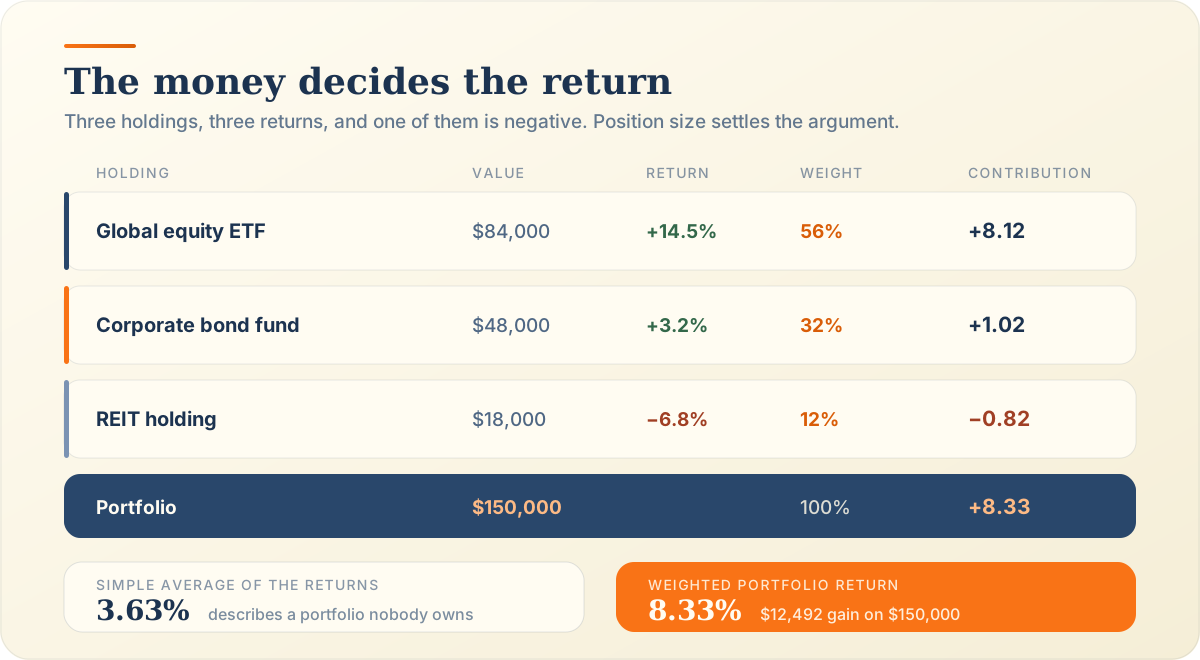
Three holdings returned 14.5%, 3.2% and −6.8% last year. Average those and you get 3.63%. The
portfolio actually returned 8.33%, and the gap is not a rounding issue.
It is position size. Fifty-six cents of every dollar sat in the holding that gained 14.5%, and only
twelve cents sat in the one that lost. A simple average pretends you split the money evenly, which
almost nobody does.
This guide covers portfolio weights, the return formula, contributions, gains against losses, mixed
asset classes, and the two return measures this one is constantly confused with. The
weighted average calculator and the
VWAP calculator handle the arithmetic, and
how to calculate a weighted average covers the general
method.
Same three returns. The weights decide which of them the portfolio actually felt.
What Is a Weighted Average Portfolio Return?
A weighted average portfolio return multiplies each holding’s return by its share of total
portfolio value, then adds the results. It reports what your money earned rather than what the
average investment earned.
How Portfolio Weights Affect Returns
A holding influences your return in proportion to how much of it you own. A brilliant 40% gain on a
tiny position barely registers.
What Is a Portfolio Weight?
A portfolio weight is one holding’s market value divided by total portfolio value. Our $84,000 equity
position in a $150,000 portfolio carries a 56% weight.
Why Investment Size Matters When Calculating Returns
Because you cannot spend percentages. The $18,000 REIT losing 6.8% cost $1,224, while the equity
position gaining 14.5% made $12,180.
How Portfolio Weights Are Calculated
Add every holding’s market value to get the portfolio total, then divide each holding by that
total. Express the results as percentages or decimals, and confirm they sum to 100%.
Calculate the Total Portfolio Value
Add current market values, not what you paid. $84,000 plus $48,000 plus $18,000 gives $150,000.
Calculate Each Investment’s Portfolio Weight
Divide each value by the total. $84,000 divided by $150,000 gives 0.56, or 56%.
Express Weights as Percentages or Decimals
Both work, provided you stay consistent. Decimals multiply straight into returns, which is why most
spreadsheets use them.
Check That the Portfolio Weights Add Up to 100%
Global equity ETF
$84,000 · 56% weight · 14.5% return
Corporate bond fund
$48,000 · 32% weight · 3.2% return
REIT holding
$18,000 · 12% weight · −6.8% return
Total$150,000 · 100% · 8.33% weighted return
Weights are shares of one pie, which is why they must total 100%. The arc lengths here are the same numbers that multiply each return.
56 plus 32 plus 12 gives exactly 100. A total of 94% means a holding is missing from your data.
Weighted Average Portfolio Return Formula
Portfolio return equals the sum of each weight multiplied by its return. Written out, that is
(w₁ × r₁) + (w₂ × r₂) + (w₃ × r₃), where the weights are decimals summing to 1.
The Portfolio Return Formula
Rp = (w1 × r1) + (w2 × r2) + … + (wn × rn)
What Each Variable Represents
Investment Weight
The share of portfolio value held in that investment, written as a decimal between 0 and 1.
Investment Return
That holding’s percentage return over the period, positive or negative, measured over the same window
as every other holding.
Portfolio Return
The single figure describing the whole portfolio. It always lands between your best and worst
holding return, never outside.
How to Calculate a Weighted Average Portfolio Return
List each investment, work out its weight from market value, find its return, multiply the two, and
add the contributions. The sum is your portfolio return, with no further division required.
Step 1: List Each Investment
One row per holding, with its current market value. Cash counts as a holding, and leaving it out is a
common first error.
Step 2: Determine the Weight of Each Investment
Divide each value by the portfolio total. Never type weights from memory, because they drift as
prices move.
Step 3: Find the Return of Each Investment
Use the same period for every holding. Mixing a year-to-date figure with a twelve-month one produces
a number that means nothing.
Step 4: Multiply Each Weight by Its Return
0.56 times 14.5 gives 8.12. That product is the holding’s contribution, and it carries its own sign.
Step 5: Add the Return Contributions
Add all contributions, respecting negatives. 8.12 plus 1.02 minus 0.82 gives 8.32.
Calculate the Total Portfolio Return
InteractiveWeights come from the money, not from you
Edit a value or a return. The weight column recalculates itself, because that is how portfolio
weights actually work.
HoldingValueReturnWeightContribution
Global equity ETF ——
Corporate bond fund ——
REIT holding ——
Weighted average portfolio return8.33%
Total portfolio value
$150,000
Gain in dollars
$12,492
Simple average of returns
3.63%
Averaging 14.5, 3.2 and −6.8 gives 3.63%. The real return is 8.33%, because 56 cents of every
dollar sits in the holding that gained 14.5%.
Because the weights already sum to 1, the sum of contributions is the answer. No extra division, as
the weighted mean calculator shows when weights are normalised.
Weighted Average Portfolio Return Example
An $84,000 equity ETF up 14.5%, a $48,000 bond fund up 3.2% and an $18,000 REIT down 6.8% produce a
weighted portfolio return of 8.33% on $150,000, against a simple average of 3.63%.
Example With Three Investments
Portfolio performance for the year
Holding
Value
Weight
Return
Contribution
Global equity ETF
$84,000
56%
+14.5%
+8.12
Corporate bond fund
$48,000
32%
+3.2%
+1.02
REIT holding
$18,000
12%
−6.8%
−0.82
Portfolio
$150,000
100%
—
+8.33
Calculate the Weight of Each Investment
84 over 150 gives 56%. 48 over 150 gives 32%. 18 over 150 gives 12%.
Calculate Each Investment’s Return Contribution
Multiply weight by return on every row. The REIT contributes −0.816, which rounds to −0.82.
Calculate the Overall Portfolio Return
8.120 + 1.024 − 0.816 = 8.33%
Interpret the Final Portfolio Return
That 8.33% equals $12,492 of gain on $150,000, which is the cross-check worth running every time.
Dollars never lie about weights.
How Investment Contributions Affect Portfolio Returns
A return contribution is one holding’s weight multiplied by its return. Contributions add to the
portfolio return exactly, which makes them the cleanest way to see which holding actually drove
performance.
What Is a Return Contribution?
The portion of portfolio return supplied by one holding. Our equity ETF contributed 8.12 of the 8.33
total.
How Larger Holdings Affect Portfolio Performance
Contributions add, they do not average. A losing position subtracts only as much as its weight allows, which is why a 6.8% loss cost the portfolio 0.82 points.
How Smaller Holdings Affect Portfolio Performance
A 12% position moves the needle by roughly a tenth of its own return. The REIT fell 6.8% and cost the
portfolio 0.82 points.
Identifying the Largest Contributor to Portfolio Return
Rank by contribution, never by return. A modest gain on a large position routinely beats a spectacular
one on a small position.
How to Calculate Portfolio Return With Gains and Losses
Negative returns enter the formula unchanged. Multiply the loss by its weight and add the negative
contribution. Nothing about the method changes, and no absolute values belong anywhere near it.
Including Positive Investment Returns
Positive contributions add straight in. 0.32 times 3.2 gives 1.024.
Including Negative Investment Returns
Keep the minus sign through the multiplication. 0.12 times −6.8 gives −0.816, not 0.816.
Calculating the Effect of Losing Investments
A loss hurts in proportion to its weight. The same −6.8% at a 40% weight would have cost 2.72 points
instead of 0.82.
Combining Gains and Losses Across the Portfolio
Add everything in one pass. Spreadsheets handle signs correctly, which the
Excel and Google Sheets guide covers with
SUMPRODUCT.
How to Calculate Portfolio Return With Different Asset Classes
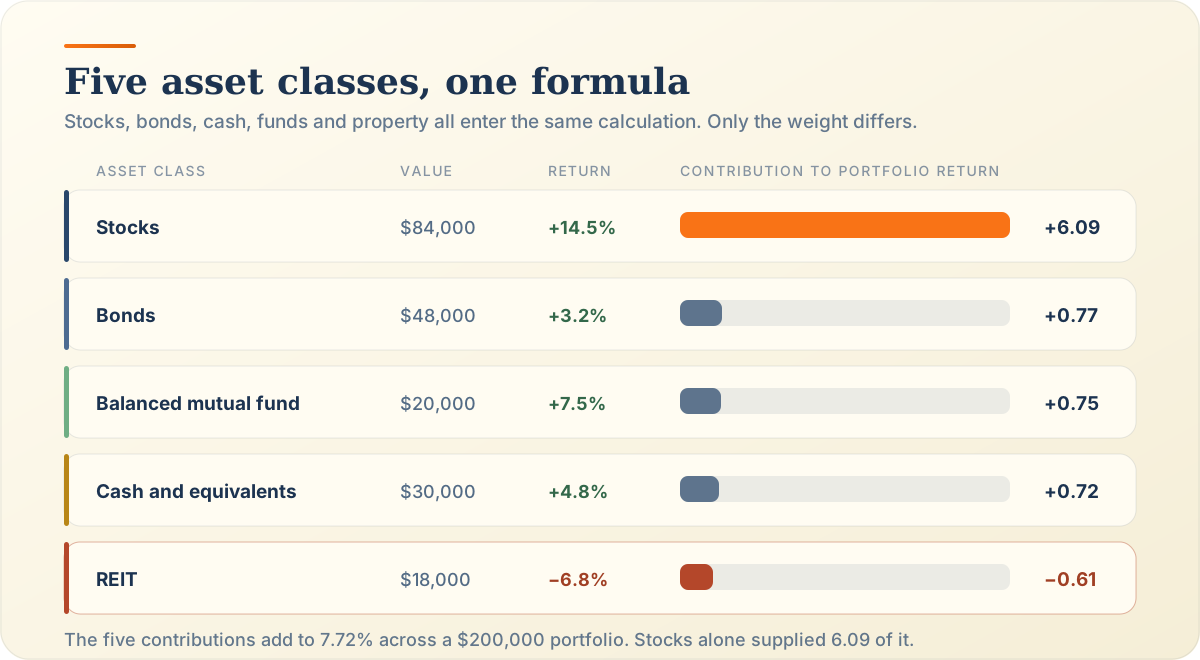
Asset classes change nothing. Stocks, bonds, cash and funds all enter the same formula, weighted by
market value. A five-class portfolio returning 7.72% uses identical arithmetic to a three-holding
one.
Stocks
Usually the largest weight and the largest swing. At 42% of a $200,000 portfolio, our stocks
contributed 6.09 of the 7.72 total.
Bonds
Lower returns, often substantial weights. Bonds at 24% contributed 0.77, more than the balanced fund
despite a far smaller return.
Cash and Cash Equivalents
Cash is a holding with a real return, not a gap in the data. At 15% earning 4.8%, it contributed 0.72
points.
Mutual Funds and ETFs
Use the fund’s own total return figure. The fund has already weighted its internal holdings, so you
weight the fund as a single line.
Cash and equivalents4.8% return · 15% weight +0.72
REIT−6.8% return · 9% weight -0.61
The five contributions add to 7.72%, the portfolio return. Stocks alone supplied
6.09 of it.
Ranked by contribution, not by return. Cash returned less than the balanced fund yet contributed almost as much, purely because there was more of it.Five classes, one formula. The contribution column is the only one that adds to anything meaningful.
Weighted Average Return vs. Simple Average Return
A simple average treats every holding as the same size. A weighted average sizes each by its share
of your money. On our portfolio they differ by 4.70 percentage points, and only one describes an
account that exists.
Why a Simple Average Can Misrepresent Portfolio Performance
It answers the question “what did the average investment do?” Nobody owns the average investment.
How Investment Weights Change the Result
Weights redistribute influence, not returns. Our equity ETF moves from one third of the answer to
fifty-six percent of it.
When the positions genuinely are equal, or when you deliberately want to measure typical holding
performance rather than portfolio performance.
Weighted Average Return for an Equally Weighted Portfolio
An equally weighted portfolio holds the same dollar amount in every position. Its weighted average
return collapses into the simple average exactly, because every weight is identical.
What Is an Equally Weighted Portfolio?
Every holding carries the same value. Three holdings mean three weights of 33.3%, rebalanced
periodically to stay that way.
How Equal Weights Affect the Calculation
The shared weight factors out of every term. Multiply three returns by 0.333 and add, and you have
divided by three.
When the Weighted Average Equals the Simple Average
Whenever the weights match. $50,000 in each of our three holdings would have returned 3.63%, exactly
the simple average, as
what a weighted average is explains more broadly.
Portfolio Return When Weights Do Not Add Up to 100%
A fully invested portfolio’s weights normally sum to 100%. If only part of the portfolio is
represented, the calculation must make clear whether the missing allocation is intentionally
excluded or should be included.
Why Portfolio Weights Normally Total 100%
Because weights are shares of one portfolio. Anything less means a position is missing from the data,
not from the account.
Handling Missing or Unallocated Portfolio Data
InteractiveYour weights only cover 85%. Now what?
The $30,000 cash position is missing from the data. Both answers below are arithmetically
correct, and they answer different questions.
85% covered15% missing
Return on the full $200,0007.00%
The four known holdings contributed 6.996 points. Dividing by the full portfolio treats the
missing cash as if it earned nothing, which understates the result unless the cash really did
earn zero.
6.996 ÷ 1.00 = 7.00%
Whichever you publish, say which one it is. An unlabelled 7.00% and an unlabelled 8.23% look
equally authoritative on a slide.
Normalizing Partial Portfolio Weights
Divide each contribution by the weight actually covered. Our 6.996 points over 0.85 gives 8.23%, the
return on the visible portion only.
Why Incomplete Weights Can Change the Result
Reporting 7.00% implies the missing 15% earned nothing. Reporting 8.23% implies it does not exist.
Label whichever you publish, because both look equally confident on a slide.
Weighted Average Portfolio Return vs. Other Return Measures
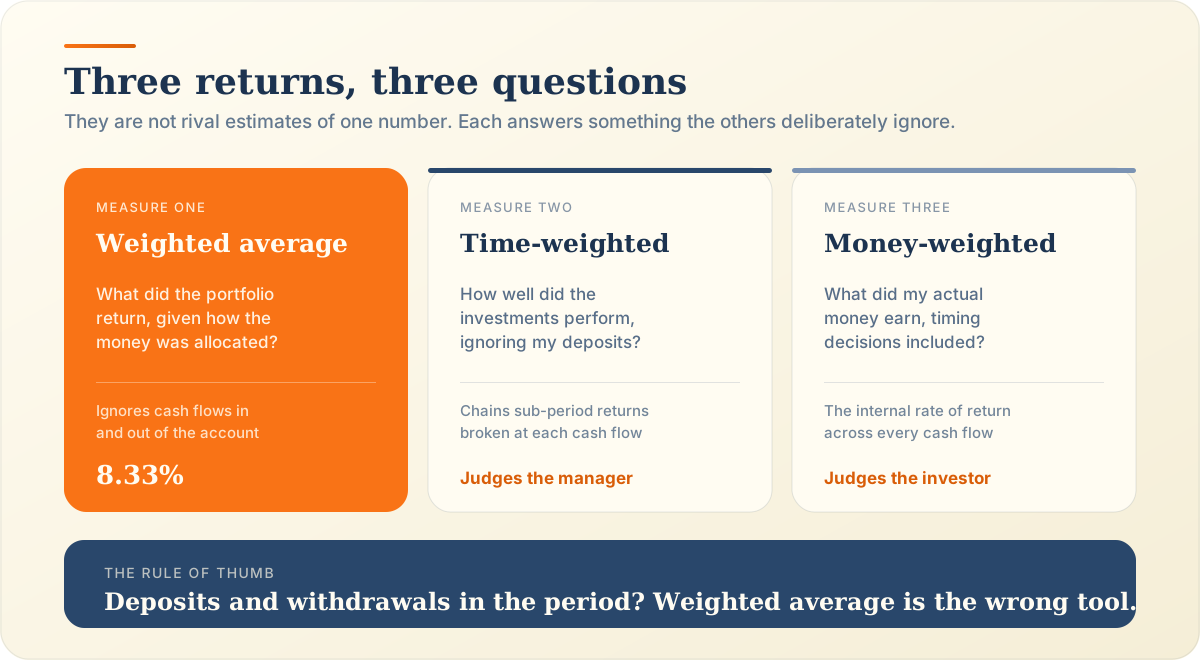
Weighted average return measures allocation over one period. Time-weighted return strips out your
deposits to judge investment performance. Money-weighted return includes them to judge your own
timing. They answer different questions.
InteractiveThree returns, three different questions
These are not competing answers to one question. They are answers to three separate questions.
Weighted average portfolio return
What did my portfolio return over one period, given how the money was allocated?
How it is built
Each holding return multiplied by its share of portfolio value, then added.
What it ignores
Deposits, withdrawals and anything that happened between the start and end dates.
Where you meet it
Statements, allocation reviews, and every example in this article.
8.33% on our three holdings
Time-weighted return
How well did the investments perform, stripping out the effect of cash going in or out?
How it is built
Break the period at each cash flow, compute a return per sub-period, then chain them.
What it ignores
The size and timing of your deposits, deliberately.
Where you meet it
Fund and manager performance, because a manager cannot control your deposits.
The industry standard for comparing managers
Money-weighted return
What return did my actual money earn, including when I added or removed it?
How it is built
The internal rate of return that sets the present value of all cash flows to zero.
What it ignores
Nothing. Timing of your own deposits changes the answer, by design.
Where you meet it
Personal performance, where your timing decisions genuinely count.
Also called the internal rate of return, or IRR
Weighted Average Portfolio Return
Best for a snapshot period with no cash moving in or out. It tells you what your allocation produced.
Time-Weighted Return
Breaks the period at every cash flow and chains the sub-period returns. The
CFA Institute’s performance standards build on it for
exactly that reason.
Money-Weighted Return
The internal rate of return across all cash flows. It rewards or punishes your timing, which is
sometimes the point and sometimes deeply unhelpful.
When These Return Measures Give Different Results
If money moved in or out during the period, the weighted average is answering a question you did not ask.
Common Mistakes When Calculating Portfolio Returns
Seven mistakes cause most wrong portfolio returns: equal weighting, wrong portfolio value, stale
weights, dropped negatives, percentage confusion, ignored cash, and mismatched measurement periods.
Giving Every Investment the Same Weight
The default error, and a 4.70 point one here. It is the simple average wearing a portfolio label.
Using the Wrong Portfolio Value
Cost basis is not market value. Weights must come from what the holdings are worth now.
Using Weights From a Different Time Period
January weights against December returns is a genuine mismatch. Prices move, so weights move with
them.
Forgetting Negative Returns
Dropping the minus sign on our REIT turns 8.33% into 9.96%. That error is invisible in a spreadsheet.
Using Percentage Weights Incorrectly
Multiplying by 56 instead of 0.56 inflates everything a hundredfold. Check the
weighted percentage calculator if the notation is tripping you.
One quarterly figure among annual ones corrupts everything. Confirm the window before you multiply.
How to Check a Weighted Portfolio Return Calculation
Confirm the weights total 100%, recompute each contribution, check the answer sits between your
best and worst holding, then rebuild it from dollar values as an independent test.
Verify the Portfolio Weights
Add the weight column. Anything other than 100% means a holding is missing or double counted.
Check Each Return Contribution
Recompute every weight times return, working up from the bottom row. Reversing direction catches what
the first pass missed.
Compare the Result With Individual Asset Returns
8.33% sits between −6.8% and 14.5%. A portfolio return outside that range is arithmetically
impossible.
Recalculate Using Portfolio Values
Total the dollar gains and divide by the portfolio value. $12,492 over $150,000 returns 8.33%,
independently confirming the whole calculation. The
weighted average interest rate calculator applies the
same balance-weighted logic to debt.
Frequently Asked Questions About Weighted Average Portfolio Returns
How do you calculate the weighted average return of a portfolio?
Divide each holding’s market value by the total portfolio value to get its weight, multiply that
weight by the holding’s return, then add the results. Our $84,000, $48,000 and $18,000 holdings
weight to 56%, 32% and 12%, and their contributions of 8.12, 1.02 and −0.82 add to 8.33%. No final
division is needed once weights sum to 1.
How are portfolio weights calculated?
Each weight is one holding’s current market value divided by the total value of the portfolio. Use
market value rather than cost basis, because weights change as prices move. An $84,000 position in a
$150,000 portfolio carries a 0.56 weight. Recalculate weights whenever you recalculate returns, since
stale weights are a common and invisible source of error.
Do portfolio weights have to add up to 100%?
For a fully represented portfolio, yes. Weights are shares of one whole, so anything less means a
holding is missing from your data. If you are deliberately analysing part of a portfolio, divide by
the weight actually covered to normalise it. Our four visible holdings covering 85% return 8.23% once
normalised, against 7.00% if the gap is treated as earning nothing.
Why is a portfolio return not a simple average of asset returns?
Because a simple average assumes equal position sizes. Averaging 14.5, 3.2 and −6.8 gives 3.63%,
which would only be correct with $50,000 in each holding. The actual allocation puts 56% in the best
performer, lifting the true return to 8.33%. The gap of 4.70 points comes entirely from position
sizing.
Can a portfolio have a negative weighted average return?
Yes, whenever losses outweigh gains once weighted. If our REIT held 70% of the portfolio instead of
12%, its −6.8% would dominate and the total would turn negative despite two profitable holdings. The
result always lands between your worst and best holding returns, so a negative total requires at
least one negative holding.
What happens when one investment has a much larger weight?
It effectively becomes the portfolio. A holding at 80% weight contributes roughly four fifths of the
reported return, and the remaining positions become rounding. This is worth watching deliberately,
because a concentrated portfolio reporting a strong number may be reporting one lucky position rather
than a working strategy.
Is weighted average return the same as time-weighted return?
No. Weighted average return weights by position size across one period. Time-weighted return weights
by time, breaking the period at each deposit or withdrawal and chaining the sub-period results. Fund
managers report time-weighted figures because they cannot control when you add money. Use it whenever
cash moved during the period you are measuring.
Is weighted average return the same as money-weighted return?
No. Money-weighted return is the internal rate of return across all your cash flows, so the timing of
your deposits changes it. Weighted average portfolio return ignores cash flows entirely and simply
weights holdings by value. Money-weighted return judges the investor, time-weighted judges the
manager, and weighted average judges the allocation.
Can weighted average return be calculated for stocks and bonds together?
Yes, and mixed portfolios are the normal case. Asset class is irrelevant to the arithmetic, since
every holding contributes its return multiplied by its share of total value. Our five-class example
combining stocks, bonds, cash, a REIT and a balanced fund returned 7.72% using exactly the same
formula as a three-stock portfolio.
Back to those three holdings. The portfolio returned 8.33%, not 3.63%, and the difference was never
about picking better investments. It was about counting the money before averaging the percentages.
More questions about weighting are answered case by case, and the
weighted average calculator prints the weighted sum and total weight side by side so
you can audit every contribution. Which position is quietly writing most of your return?
The weighted average calculator multiplies each value by its weight, adds the weighted sum, divides by the total of weights, and prints the weighted average beside the standard arithmetic mean. Course grades, GPA, portfolio returns, and probability distributions all run through the same 4 steps.