
A finance director once told me her team spent three hours debating whether their quarterly report should say "weighted average cost" or "weighted mean cost." The calculation was identical. Only the label changed. That conversation happens more often than you might expect, and it reveals a genuine gap in how people understand these three terms.
The confusion between weighted average, weighted mean, and arithmetic mean costs real time in classrooms, boardrooms, and research labs every day. This guide breaks down each concept with clear definitions, interactive comparisons, and practical examples so you never second-guess the terminology again. Use our weighted average calculator alongside this article to test every concept in real time.
Why These Three Terms Are Often Confused
People confuse these terms because textbooks, industries, and even software tools use them inconsistently. A statistics professor says "weighted mean." A financial analyst says "weighted average." A teacher says "average." All three might describe the same operation, or they might not.
Similar Names, Different Contexts
The word "average" appears in casual conversation, business reports, and peer-reviewed journals. Each audience interprets it differently. Students learn "mean" in math class but hear "average" everywhere else. This naming overlap creates unnecessary confusion.
Why Different Industries Use Different Terminology
Finance adopted "weighted average" because investors understand "average" intuitively. Statistics kept "weighted mean" because it fits the formal vocabulary of central tendency measures. Education uses both, depending on the textbook publisher. The result is three labels for what often turns out to be two distinct calculations.
The Most Common Misunderstandings
Most people assume these are three separate formulas. They are not. Weighted average and weighted mean use the same formula. The arithmetic mean uses a simpler version where all weights are equal. Understanding this distinction saves hours of confusion.
Are They Really Different?
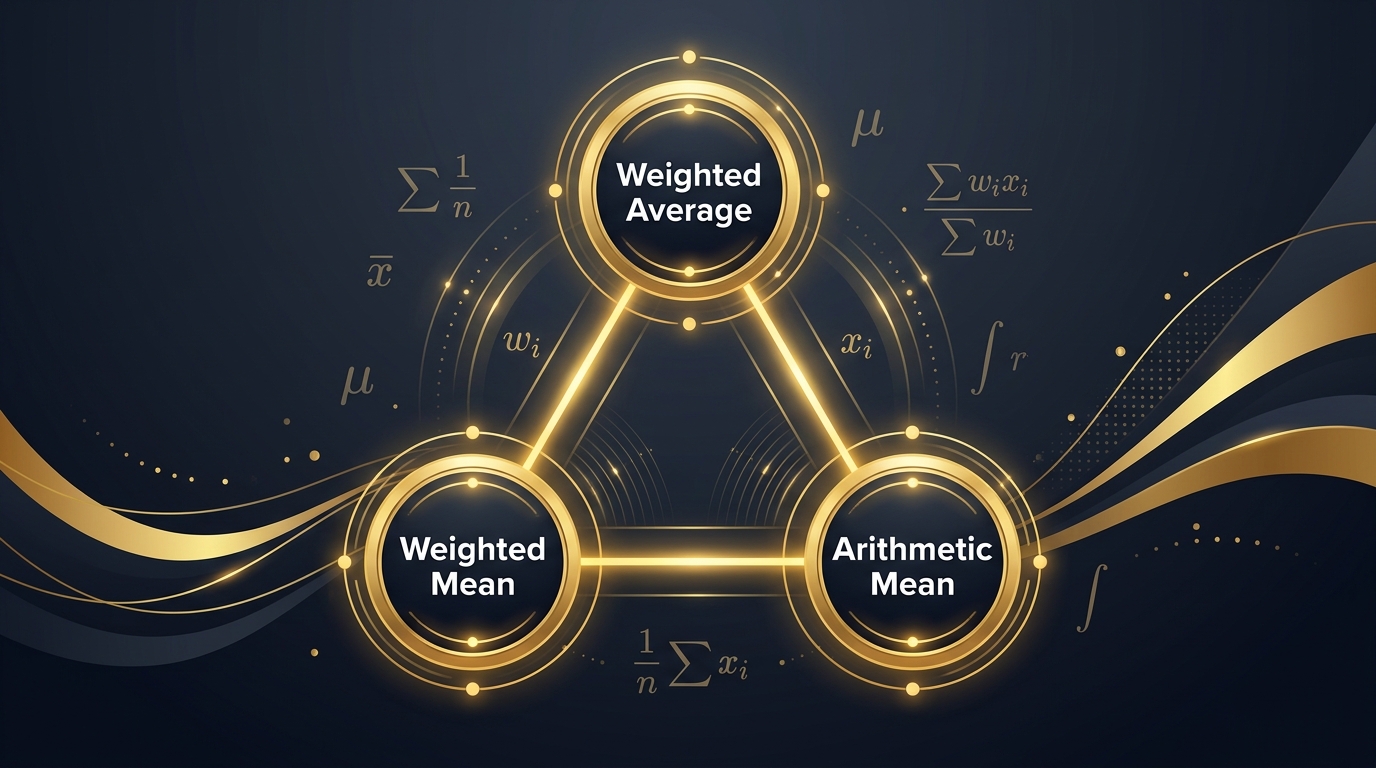
Weighted average and weighted mean are mathematically identical. The arithmetic mean is a special case of both, where every weight equals one. Think of it this way: every arithmetic mean is a weighted average, but not every weighted average is an arithmetic mean.
How These Three Concepts Relate
DiagramWhat Is an Arithmetic Mean?
The arithmetic mean adds all values together and divides by the total count. Every number contributes equally to the final result, regardless of its real-world importance. It is the most familiar type of average.
Definition
The arithmetic mean formula is straightforward: sum all values, then divide by how many values you have. For values 80, 90, and 70, the arithmetic mean equals (80 + 90 + 70) divided by 3, which gives 80. No value gets special treatment.
How Equal Importance Affects the Result
Equal weighting works perfectly when every data point truly matters the same amount. Class test scores where each test counts equally, daily temperatures across a week, or monthly expenses with no priority ranking all fit the arithmetic mean well.
Characteristics of an Arithmetic Mean
The arithmetic mean responds equally to every value. One extremely high or low number can pull the result significantly. This sensitivity makes it powerful for balanced data but misleading for skewed data sets. Learn more about how this compares in practice with our guide on calculating weighted averages manually.
Everyday Example
You buy coffee five times this week at prices of 4, 5, 4, 6, and 5 dollars. The arithmetic mean is 4.80 dollars. Each purchase matters equally because you drank each cup the same way. No coffee was more important than another.
What Is a Weighted Mean?
A weighted mean multiplies each value by an assigned weight, sums those products, and divides by the sum of all weights. It is the formal statistical term for an average that accounts for varying importance across data points.
Definition
Statisticians define the weighted mean as a measure of central tendency where each observation contributes proportionally to its assigned weight. This definition appears in most statistics textbooks published after 1950.
Why Some Values Carry More Influence
Real data rarely arrives in equal portions. Survey responses from 10,000 participants should outweigh responses from 100. A final exam worth 40% of a grade should matter more than a quiz worth 5%. The weighted mean captures this reality.
Key Characteristics
The weighted mean always falls between the smallest and largest values in a data set. Larger weights pull the result toward their associated values. Changing a single weight can shift the entire result dramatically, which is why verifying your inputs matters. See our guide on checking calculator results for verification techniques.
Understanding Statistical Weighting
Statistical weighting adjusts for sample sizes, reliability differences, or known population proportions. Researchers assign weights based on study design. A clinical trial might weight results from a larger hospital more heavily than results from a smaller clinic because the larger sample provides more reliable data.
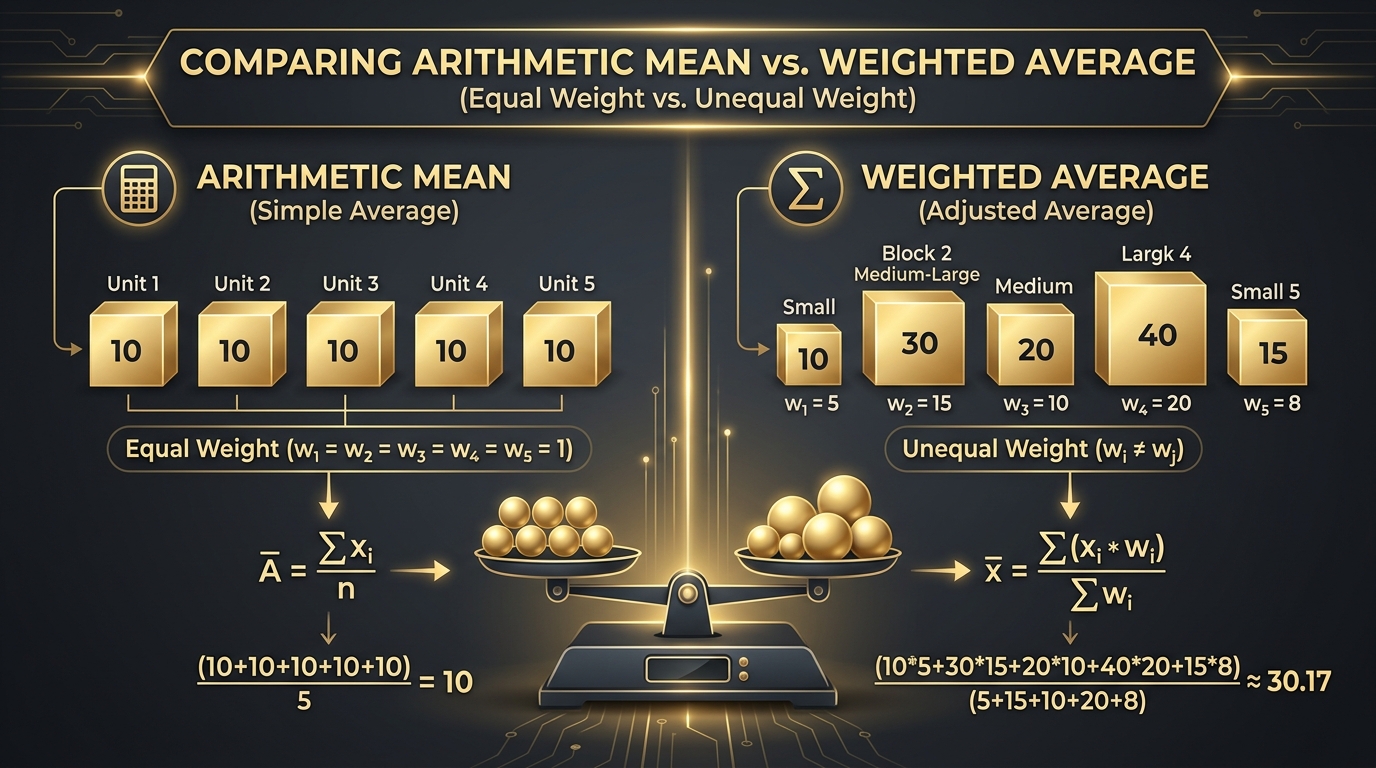
Equal weighting (arithmetic mean) versus proportional weighting (weighted mean) produce different results from identical data
What Is a Weighted Average?
A weighted average is the commonly used name for the same calculation that statisticians call a weighted mean. The formula is identical: multiply each value by its weight, sum the products, and divide by total weight.
Definition
The weighted average takes a set of values and a corresponding set of weights, computes each value-weight product, and produces a single representative number. Business professionals, educators, and software tools prefer this name because it feels intuitive.
Why the Term "Weighted Average" Is More Common
Google search data consistently shows that "weighted average" receives roughly five times more searches than "weighted mean." People outside academia gravitate toward "average" because they encounter it first in everyday life. Textbooks may say "mean," but the workplace says "average."
Relationship to Weighted Mean
The relationship is simple: weighted average and weighted mean are the same calculation with different names. No mathematical distinction exists between them. If someone asks for a weighted mean and you deliver a weighted average, you gave the correct answer.
Why Different Books Use Different Names
Publishing conventions vary by discipline. Statistics textbooks published by academic presses favor "weighted mean." Business and finance textbooks from trade publishers prefer "weighted average." Neither is wrong. The formula on the page is identical.
Weighted Average vs Weighted Mean: Is There Actually a Difference?
No. Weighted average and weighted mean are two names for the exact same mathematical operation. The distinction is purely linguistic. One term comes from everyday language, the other from formal statistics.
Mathematical Perspective
Both use the formula: sum of (value times weight) divided by sum of weights. Write it in mathematical notation or plain English. The computation never changes. Every math textbook that defines both terms confirms they produce identical results.
Statistical Perspective
Statisticians prefer "weighted mean" because "mean" is the technical term for a measure of central tendency. Using "mean" signals precision and follows established naming conventions in the field.
Practical Usage
Finance professionals say "weighted average cost of capital." Statisticians say "weighted mean of the sample." Both describe the same calculation applied to different contexts. The terminology signals your audience, not your method.
Academic Terminology
Academic papers almost exclusively use "weighted mean." Industry reports almost exclusively use "weighted average." If you write for both audiences, pick one term and define it clearly at the beginning.
When Both Terms Mean Exactly the Same Thing
Always. There is no scenario in standard mathematics where weighted average and weighted mean produce different results given the same inputs. They are synonyms.
Interactive: Compare All Three Methods
Live DemoStudent grades: Homework (75), Midterm (85), Final Exam (92)
Adjust the weights to see how each method responds:
Arithmetic Mean vs Weighted Average
The arithmetic mean treats every value equally, while the weighted average lets you assign different levels of importance to each value. This fundamental difference determines which method gives you a more accurate picture of your data.
Equal Contribution vs Unequal Contribution
With an arithmetic mean, a quiz worth 5 points and a final exam worth 200 points both influence the average equally. That rarely reflects reality. The weighted average fixes this by letting the final exam carry proportionally more influence.
How Data Importance Changes the Result
Consider a portfolio with 90% in bonds returning 4% and 10% in stocks returning 15%. The arithmetic mean says 9.5%. The weighted average says 5.1%. The weighted result accurately reflects what the portfolio actually earned. The arithmetic mean overstates stock performance because it ignores allocation size.
Typical Applications
Use the arithmetic mean for uniform data: daily step counts, identical test scores, or evenly sampled temperature readings. Use the weighted average for varied data: GPA calculations, portfolio returns, or survey results from groups of different sizes. Explore more scenarios in our guide on when to use a weighted average calculator.
Side-by-Side Comparison Table
| Feature | Arithmetic Mean | Weighted Average |
|---|---|---|
| Formula | Sum of values / count | Sum of (value x weight) / sum of weights |
| Weight handling | All weights equal (implicitly 1) | Each value has a custom weight |
| Best for | Uniform, equally important data | Data with varying importance |
| Complexity | Simple | Slightly more complex |
| Outlier sensitivity | High (every point equal) | Controllable (adjust weights) |
| Common fields | Basic statistics, daily averages | Finance, education, research |
Comparison Matrix: Weighted Average vs Weighted Mean vs Arithmetic Mean
This matrix compares all three methods across seven critical dimensions. Use it as a quick reference when deciding which approach fits your situation.
Formula
Arithmetic mean: sum divided by count. Weighted average and weighted mean: sum of weighted products divided by sum of weights. Two formulas total, three names.
Data Requirements
The arithmetic mean needs only values. The weighted average and weighted mean need values plus corresponding weights. More inputs means more room for error, which is why double-checking matters.
Weight Usage
Arithmetic mean ignores weights entirely (or treats them all as one). Weighted average and weighted mean require explicit weight assignments for every value.
Accuracy
For uniform data, all three produce the same result with equal accuracy. For non-uniform data, the weighted methods reflect reality more faithfully because they account for varying importance.
Typical Applications
Arithmetic mean: temperature averages, simple test scores, basic survey results. Weighted average: GPA, portfolio returns, cost accounting. Weighted mean: population studies, meta-analysis, stratified sampling.
Advantages
The arithmetic mean wins on simplicity. The weighted methods win on precision for real-world data where importance varies.
Limitations
The arithmetic mean distorts results when data importance varies. The weighted methods require careful weight assignment and can mislead if weights are chosen poorly.
Quick Comparison Chart
| Dimension | Arithmetic Mean | Weighted Average | Weighted Mean |
|---|---|---|---|
| Formula | Sum / n | Sum(w*x) / Sum(w) | Sum(w*x) / Sum(w) |
| Requires weights | No | Yes | Yes |
| Formal term | Yes | Informal | Yes |
| Used in academia | Always | Sometimes | Always |
| Used in business | Sometimes | Always | Rarely |
| Handles unequal data | Poorly | Accurately | Accurately |
| Ease of use | Very easy | Moderate | Moderate |

Different industries rely on different terminology, but the underlying mathematics often overlaps
Which Average Should You Use?
Choose your method based on whether your data points carry equal or unequal importance. The right choice depends on context, not preference.
Education
Use a weighted average for GPA calculations where courses have different credit hours. A 4-credit A matters more than a 1-credit B. The arithmetic mean would treat them the same, giving an inaccurate GPA.
Statistics
Use a weighted mean when combining data from samples of different sizes. Meta-analyses in medical research weight larger studies more heavily because they provide more reliable estimates.
Finance
Use a weighted average for portfolio returns, weighted average cost of capital, and inventory costing. Every major financial model that involves proportional allocation uses weighted calculations.
Business Reporting
Use a weighted average when aggregating performance metrics across departments or regions of different sizes. A region with 10,000 customers should influence the company average more than a region with 500.
Scientific Research
Use a weighted mean when measurements have different levels of precision. A reading from a calibrated instrument with low uncertainty deserves more weight than a rough estimate.
Choosing the Appropriate Average
Ask one question: do all my data points matter equally? If yes, use the arithmetic mean. If no, use the weighted average (or weighted mean, since they are the same thing).
Decision Flowchart: Which Average to Use
GuideSituations Where All Three Produce the Same Result
All three methods give the same answer when every data point carries equal weight. This happens more often than people realize.
Equal Weights
Assign weight 1 to every value. The weighted average formula reduces to the arithmetic mean formula because identical weights cancel out. You get the same number either way.
Equal Values
If every value in your data set is the same (say, 50 across the board), every averaging method returns 50. Weights become irrelevant when there is no variation to shift.
Uniform Data Distribution
When both values and weights are uniformly distributed, the proportional effects of weighting balance out. The result converges to the arithmetic mean.
Why This Happens
Mathematically, the weighted average formula with equal weights simplifies to sum of values divided by count. The weight terms divide out. This is not a coincidence but a fundamental property of the formula. Try it yourself with our weighted average calculator by setting all weights to the same number.
Situations Where the Results Are Completely Different
Results diverge sharply when weights are unequal and values vary significantly. These are the scenarios where choosing the right method matters most.
Unequal Weights
A portfolio with 80% bonds at 3% return and 20% stocks at 12% return shows this clearly. Arithmetic mean: 7.5%. Weighted average: 4.8%. The weighted result reflects actual earnings.
Uneven Data Distribution
Survey data from a group of 5,000 respondents and a group of 50 respondents should not be averaged equally. The larger group provides more statistical power and deserves proportional weight.
High-Impact Observations
In quality control, a defect rate from a production run of 100,000 units matters far more than a rate from a test batch of 100 units. Treating them equally could mask serious quality problems.
Real-World Comparison Scenario
Imagine a student earns 95 in a 5-credit course and 60 in a 1-credit course. The arithmetic mean is 77.5. The weighted average is 89.2. That 11.7-point difference could mean the difference between passing and failing a scholarship threshold.
Advantages and Limitations of Each Method
Arithmetic Mean
Advantages
- Simple to calculate and easy to explain
- Works well for uniform data with equal importance
- Requires fewer inputs (no weight assignments needed)
- Universally understood across all audiences
Limitations
- Distorts results when data points have unequal importance
- Highly sensitive to outliers with no way to reduce their impact
- Can produce misleading summaries for skewed distributions
- Ignores real-world context about data significance
Weighted Mean
Advantages
- Reflects true data importance through formal weight assignments
- Produces more accurate central tendency for non-uniform data
- Recognized as the standard in academic and research contexts
- Flexible enough to handle any weighting scheme
Limitations
- Requires weight selection, which introduces subjective judgment
- More complex to explain to non-technical audiences
- Incorrect weights produce confidently wrong results
- Less intuitive than a simple arithmetic mean for beginners
Weighted Average
Advantages
- Same mathematical precision as weighted mean
- More widely recognized name in business and everyday use
- Supported by virtually every spreadsheet and calculator tool
- Easy to implement in financial models and reports
Limitations
- Same weight-selection challenges as the weighted mean
- Can be confused with a simple average by untrained users
- Results are only as good as the weights you assign
- Requires verification to ensure weight accuracy
Common Myths About Means and Averages
Weighted Mean and Weighted Average Are Always Different
This is false. They are mathematically identical. The names come from different traditions, not different formulas. Every major reference confirms this equivalence.
Arithmetic Mean Is Always More Accurate
Also false. The arithmetic mean is only more accurate when all data points have equal importance. For any data set with varying significance, the weighted methods produce results closer to reality.
Weighting Always Produces Better Results
Not necessarily. Poor weight choices can distort results worse than no weighting at all. Weighted methods require thoughtful, justified weight assignments. Random or arbitrary weights create unreliable answers.
Every Average Requires Weights
False. The arithmetic mean uses no explicit weights. You only need weights when data points have different levels of importance. For uniform data, the simpler arithmetic mean works perfectly.
Frequently Asked Questions
Is a weighted average the same as a weighted mean?
Yes. Both terms describe the same calculation. Weighted mean is the formal statistical term, while weighted average is the everyday name used in business, education, and finance. The formula and result are identical.
What is the difference between an arithmetic mean and a weighted mean?
An arithmetic mean treats every value equally. A weighted mean assigns a specific weight to each value so that more important data points have a greater influence on the final result.
Why do statisticians prefer the term weighted mean?
Statisticians use weighted mean because it aligns with formal naming conventions in probability and statistics, where "mean" refers to a measure of central tendency.
Why do finance professionals use weighted average?
Finance professionals prefer "weighted average" because the term "average" is more widely understood by investors, clients, and stakeholders in business contexts.
Can weighted average and arithmetic mean be equal?
Yes. When every weight is the same, the weighted average produces the exact same result as the arithmetic mean. Equal weights cancel out their effect on the formula.
Which method is more accurate?
Neither method is universally more accurate. The arithmetic mean works best for uniform data. The weighted average works best when data points have different levels of importance.
Is weighted average used only in statistics?
No. Weighted averages appear in education for GPA calculations, in finance for portfolio returns, in manufacturing for quality control, and in dozens of other fields.
Do all weighted averages require percentages?
No. Weights can be whole numbers, decimals, or percentages. The formula divides by total weight automatically, so any consistent weighting system works correctly.
Which average should students use?
Students should use a weighted average when course credits or assignment categories have different point values. For simple test scores with equal weight, the arithmetic mean works fine.
Is weighted mean a statistical term?
Yes. Weighted mean is the formal term used in statistics textbooks, academic papers, and research publications. It follows standard statistical naming conventions for measures of central tendency.
Conclusion
The difference between these three terms is smaller than most people assume. Weighted average and weighted mean are the same formula with different names. The arithmetic mean is a simplified version that works only when all data matters equally. Once you understand this relationship, the terminology debate disappears.
For most practical work, the weighted average is what you need. It handles GPA calculations, portfolio analysis, survey aggregation, and any scenario where some numbers carry more importance than others. The arithmetic mean remains useful for quick, equal-weight calculations.
Stop debating labels and start focusing on whether your data needs weights. If it does, use the weighted approach. If every data point matters the same, the arithmetic mean gives you the fastest answer. Either way, our weighted average calculator handles both calculations instantly.